September 07, 2026
Seattle, July 2026. I was floating on my back in Lake Washington, about a hundred yards offshore of Seward Park. The early morning air was cool, but the water was warmer than the air, and the sun shining on my closed eyes was warmer still. One thing marred this moment of tranquility — I wasn’t supposed to be floating on my back! I was supposed to be swimming. I heard splashing around me from the dozens of people maneuvering their way around me, treating me as an obstacle in the way of their quarter-mile loop through the water and back to shore. It was the opening leg of the “super-sprint” distance of the Seafair Triathlon. I also should have been working my way along the loop and back to shore, but I’m a terrible swimmer, I was tired, and I needed a break. So, I was on my back, relaxing.
All my life, I’ve told myself, “I can’t swim.” How did I wind up in a triathlon? Short answer: gentle peer pressure. I’m grateful for it.
It started in February, when my coworker Nat posted about the Seafair Triathlon in one of our internal Duolingo Slack channels. She was trying to find other participants so we could get Duolingo to pay our entry fees.1 I mentioned I might sign up for the duathlon option. I enjoy biking and running, I said… but I can’t swim. Nat’s reply:
FWIW, when I did this a couple years ago for the first time, I had not swum since I was in elementary school. There are a lot of great resources online about freestyle technique and it was fun to work on a new skill :-) And there’s a lot of time between now and July!
That planted the seed in my head. Maybe I, too, could learn a new skill. And at my age! I mentioned the idea to my wife. She’d done the triathlon years before and reassured me the event was safe. “There’s so much support,” she said. “There are lifeguards on paddleboards every ten feet.” Others reassured me that a quarter mile wasn’t that far. “You can dog paddle that distance,” someone said. So, in March, I signed up.
Let me be more precise about my swimming ability when I started this adventure; “I can’t swim” covers a lot of territory. Growing up in the hot summers of Northern Virginia, I spent a lot of time in pools. I’m comfortable in the water. Some people can’t swim because they panic when they submerge their face. That’s not me! As a kid, I loved diving to the bottom of the deep end of the pool to retrieve pennies or pool toys. I can dog paddle, tread water, and do something that looks like a breaststroke. When I say “I can’t swim,” I mean that I can’t do the front crawl. The mechanics of that stroke have eluded me my whole life. Windmilling my arms in the water accomplished nothing except splashing. As far as I was concerned, “side breathing” was as much a myth as the Loch Ness Monster. I could only breathe by keeping my whole head out of the water. Basically, I knew how to have fun in a backyard pool. I’d never swum a 25-yard lap in my life when I signed up for the triathlon… and now I had a few months to learn how to swim 440 yards in one go.
I signed up for group swim lessons at the University of Washington IMA pool, but they started a mere two weeks before the triathlon. I knew I needed to practice on my own. Enter “YouTube University” — it’s amazing what you can learn online! For example, early on I had the common problem of my legs sinking. It was impossible for me to keep my body in a streamlined position at the surface of the water. YouTube University helped here: I watched a video that explained that your body in water was like a seesaw, with your lungs as the fulcrum; to get your legs to rise, you need to push your head and chest down. It worked!
I did floating drills. I did kicking drills. I practiced rolling from my front to my back. I focused on staying streamlined in the water. Then one day, a few weeks before the triathlon, it happened — for the first time in my life, I swam the front crawl 25 yards uninterrupted. I was out of breath and my heart was racing, but I’d done it. This old dog had learned a new trick.
Between that first milestone and the day of the triathlon itself, in addition to my solo practice in the pool, I had two group lessons and two open-water swim sessions at the Laurelhurst Beach Club. In the safe environment of a lifeguard-supervised swimming area in Lake Washington, I made sure I could stay in the water for 20 minutes without holding on to anything — a combination of swimming, treading water, and floating on my back when I was tired.
July: Decision time. My mom, worried for me and hearing I’d only had two lessons, encouraged me to push this off until next year. Here’s where gentle peer pressure came into play. Although I’m certain my coworkers would have understood if I had waited another year, I didn’t want to “lose face” with them. Plus, I coveted the feeling of pride that would come from accomplishing something new. I knew my quarter-mile swim in Lake Washington was going to be a challenge, but I didn’t think it was reckless. I’d practiced floating on my back, and I knew I was welcome to hold on to the lifeguards’ paddleboards if I needed more of a break. I decided to stick with the original plan and race the triathlon this year. That’s how I found myself the morning of July 19, standing knee-deep in the water, waiting for my wave to start.
I experienced some of the differences between pool swimming and lake swimming from the very beginning, as I waded into the water. There’s no wall to push off of, and no clear marker to say, “This is when it makes sense to stop trying to walk through the water and instead try to swim.” You just have to decide it’s time to throw your body forward. I stretched myself on the surface of the water, trying to hold a streamline position to minimize drag, moved my right arm, my left arm, rotated to my right to take a breath in the choppy water — and just had to stop, lift my head, and breathe.
I tried again: Streamline, right arm, left arm, rotate — stop.
All of the front-crawl practice I’d done over the preceding weeks was pretty much useless. I couldn’t establish any sort of rhythm. One thing I realized while learning how to swim is how much easier things are once you relax. I’d learned how to relax in a pool when I had a lane to myself. With the adrenaline of a race, in a lake, surrounded by the splashing of dozens of other beginner swimmers, relaxing was impossible. While I thought I didn’t panic in the water at the time, looking back on it now, remembering right arm, left arm, rotate, stop — maybe I was having little micro-panics. I wasn’t mentally ready to have my face in the water, unable to see, with all of those kicking legs around me.
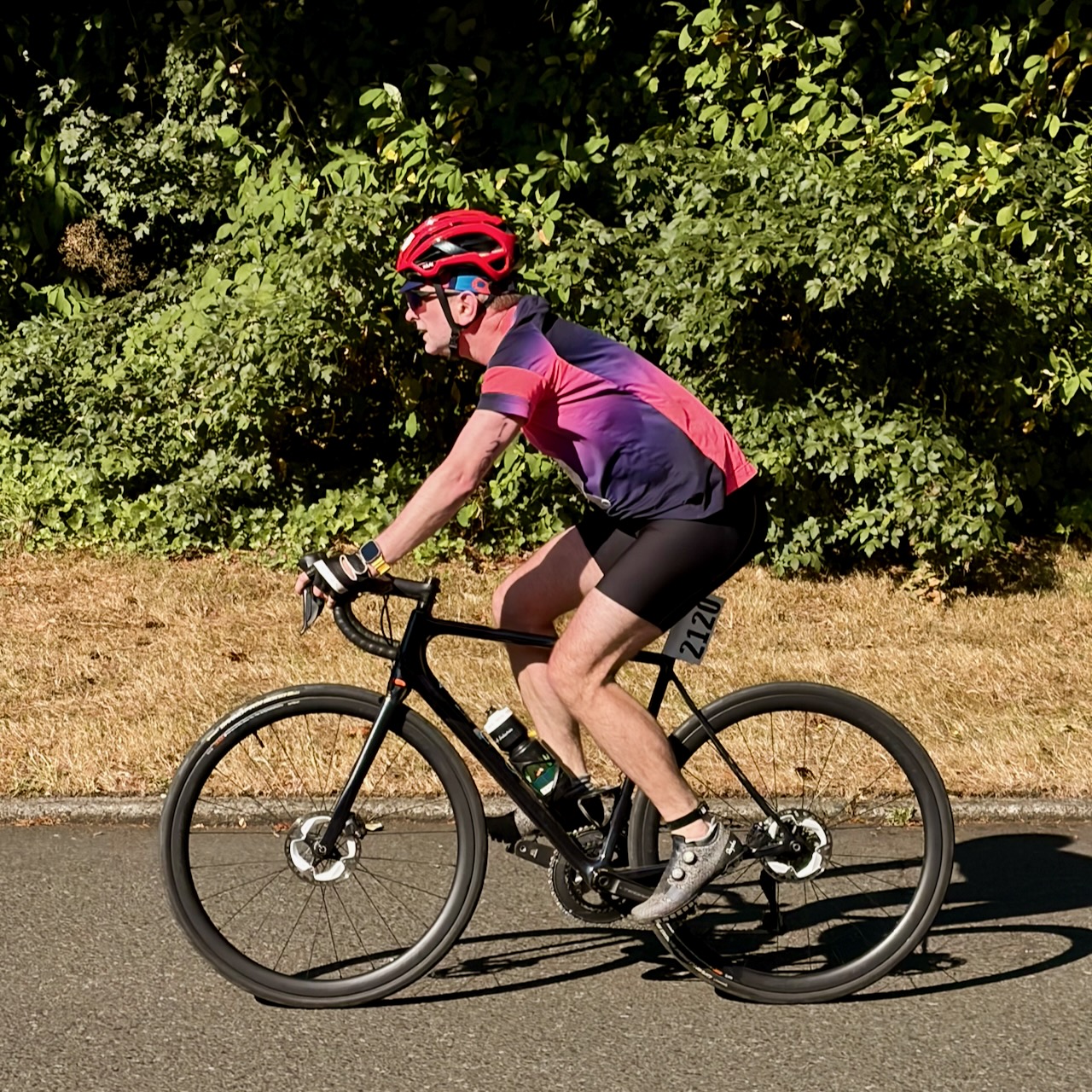
If I couldn’t swim more than two strokes, how did I finish? By resorting to the swim style I’ve done since being a kid: an extraordinarily inefficient breaststroke, with my head above the water most of the time and my legs dragging far below the surface. It was slow, it was tiring, and I needed to take breaks with the lifeguard paddleboards. But it felt safe because I could see where I was going, I could breathe whenever I wanted, and — probably most important — it was the natural way for me to move through the water without thinking. In the high-stress environment of the triathlon, that mattered. I finished, but it took me a long time. When I emerged dripping from Lake Washington, even though I still had the bike and the run legs in front of me, I already felt like I’d won.
While I didn’t wind up doing the front crawl in the triathlon, the breakthrough of swimming a single lap in the pool made me shed my belief of “I can’t swim.” It got me into the lake in the first place. I now swim about as well as a mediocre eight-year-old whose parents are urging them to join the swim team for the summer. Here’s the tough part about getting old and trying new things: Everybody starts out being bad at things. Why would I want to spend my time being bad at things when there are so many things I’m good at? Yet somehow, I find myself going back to the pool two or three times per week. I finished my group swim lesson, and I’m doing a combination of drills and simply “putting in the reps.” For my first triathlon, it took all of my concentration even to swim badly. By next summer, I hope I’ve progressed to where moving through the water is as natural as — maybe not walking, but at least riding a bike. I’m glad I pushed through this discomfort to feel the pride of accomplishing something new. And I’m grateful to my coworkers Nat and Isabel for getting me to sign up, making sure I would’ve felt awkward to back out, and waiting probably an hour after the end of their races to cheer for me at the finish line.
That’s a fun thing about working for Duolingo. To encourage coworkers to do things outside of work together, you can expense up to $100 per person per month on social activities. The only conditions are that the event be open to the whole office (no private cliques) and meet a minimum number of attendees (the minimum varies with the size of the office). ↩︎